
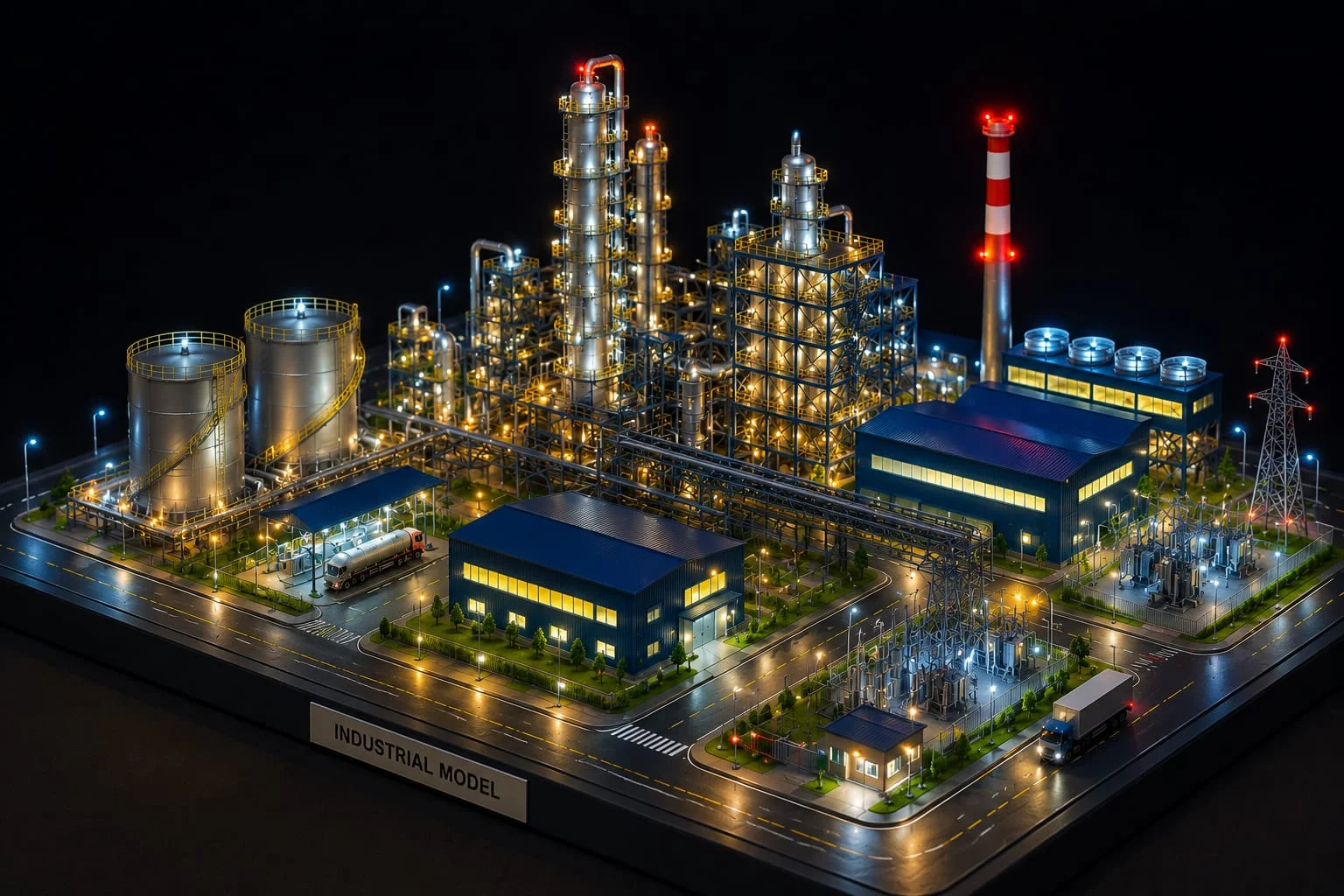
A Single Model Serving Multiple Audiences
Few categories of scale model get used across as many different contexts as industrial facility work. The same physical piece might get photographed for an investor deck one month, used in a safety orientation session for new employees the next, and then brought out again during a community consultation meeting about a planned expansion. Each of these audiences needs something slightly different from the same object, which makes planning an industrial plant model more complex than it might first appear.
Investors generally care about scale, impressiveness, and a clear sense of the operation’s scope — how large the facility is, how it fits within the surrounding land, and a general sense of the process without necessarily needing granular technical detail. New employees in a safety orientation, by contrast, need to understand specific hazard zones, emergency exits, and equipment access points with real precision, since that understanding could genuinely matter in an emergency.
Building for Safety Training Specifically
When a model is intended primarily for safety and training use, accuracy around emergency exits, fire suppression equipment locations, and hazard zones needs to be treated as a priority over purely aesthetic considerations. This sometimes means the model needs removable sections or a layered design that lets a trainer walk through specific scenarios — showing an evacuation route, for instance, without the visual clutter of every other detail competing for attention at the same time.
Facilities handling flammable materials, chemical processes, or heavy machinery often benefit from a model that clearly separates different hazard classifications by color or marking, mirroring the safety documentation used in actual employee training. This turns the model from a passive display object into an active teaching tool that trainers can reference repeatedly, pointing to specific zones as they walk new employees through procedures.
Building for Investor and Community Presentations
For investor-facing use, the priorities shift somewhat. Overall visual impact, a clear sense of scale relative to familiar reference points, and a polished finish that reflects well on the company’s professionalism tend to matter more here than the granular safety detail a training model needs. This doesn’t mean accuracy is unimportant — investors still need a genuine representation of the project — but the emphasis leans more toward communicating scope and ambition clearly at a glance.
Community and regulatory presentations sit somewhere between these two use cases, needing enough technical honesty to build trust with skeptical stakeholders while still being approachable to a general, non-technical audience. An industrial plant model built for this purpose often benefits from clear labeling and a guided viewing sequence — literally walking a viewer around the model in an order that tells a coherent story about how the facility will operate and what safeguards are built in.
Planning for Multiple Uses From the Start
Given how differently these audiences use the same object, it’s worth having an honest conversation with the model maker at the outset about every intended use, rather than assuming a single generic build will serve every purpose equally well. Some companies commission two versions — a highly detailed technical model for internal training use and a more polished, simplified version for external presentations — rather than trying to force one model to do both jobs.
For companies working with a tighter budget that can only commission one version, prioritizing which use case matters most — investor confidence, employee safety training, or community trust — helps the model maker make better decisions about where to invest detail and polish, rather than spreading the effort thin trying to satisfy every audience equally.
Treating It as an Ongoing Communication Tool
Once built, these models often have a longer working life than people initially expect, getting pulled out repeatedly for new employee orientations, follow-up investor updates, or subsequent community meetings well after the original commissioning purpose has passed. Treating the model as a durable, reusable asset rather than a single-event prop tends to justify a more thoughtful initial investment in its build quality.
Facilities that plan for this longer usage from the outset — choosing durable materials and construction that can survive years of repeated handling — generally get considerably more value out of their industrial plant model than those that commission something built to last only through a single event.
Coordinating Across Departments From the Start
Because these models often serve safety, investor relations, and community engagement teams simultaneously, it helps to involve representatives from each department in the initial planning conversation with the model maker, rather than having one department commission it in isolation and hope it serves everyone else’s needs adequately by coincidence.
This kind of cross-departmental input at the outset tends to produce a model that genuinely serves its several intended audiences well, rather than one that excels for whichever department happened to drive the original commissioning decision while leaving the others working around a tool that wasn’t really built with their needs in mind.
Involving the People Who Will Actually Use It
Whoever will actually be using the model day-to-day — safety trainers, sales staff, community relations teams — should ideally have some input into its design, since they understand firsthand which details matter most for their specific conversations. A model designed purely by management without this frontline input sometimes misses practical features that would have made everyday use considerably easier.
This kind of inclusive planning process takes a bit more coordination upfront, but it consistently produces a more genuinely useful finished piece than one designed in isolation from the people who will actually be standing next to it, answering questions, for years to come.
Measuring Whether It’s Actually Working
It’s worth periodically checking whether the model is actually achieving its intended purpose across its different audiences — are new employees genuinely retaining safety information better because of it, do investors reference it positively, does the community engagement team find it helps de-escalate concerns during public meetings.
This kind of informal feedback loop, gathered from the people actually using the model regularly, helps identify whether adjustments or updates are needed, rather than assuming the original build continues serving its purpose well indefinitely without ever checking back in on that assumption.
